Course
Study programs
Medical Studies in EnglishYear of study
2ISVU ID
ECTS
10
Student grading will be conducted according to the current Ordinance on Studies of the University of Rijeka (approved by the Senate) and the Ordinance on Student Grading at the Faculty of Medicine in Rijeka (approved by the Faculty Council).
Assessment of student work
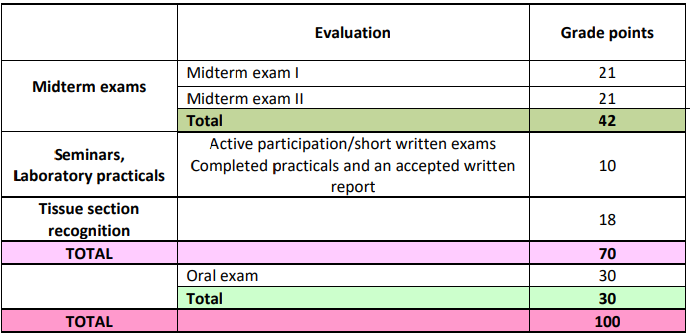
Student work will be assessed and graded during the course and on the final exam. During the course, students may obtain a total of 100 grade points (credits). Students can achieve up to 70% of the final grade during the classes, and a maximum of 30% of the final grade at the final exam. Evaluation of students’ progress during classes, midterms, and the final exam in the academic year 2022/2023 is shown in Table 1.
Table 1. Distribution of grade points in the course “Histology and Embryology“
Written midterm exams
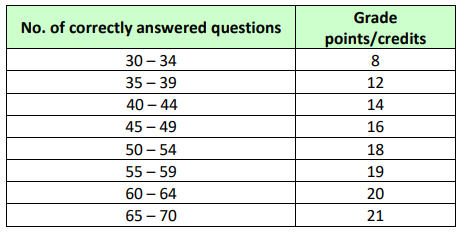
During the semester, two written midterm exams are planned that will include the content of lectures, seminars, and laboratory practicals. MT I – general histology and basic embryology. MT II – histology and embryology of various organs. 9 At each midterm exam, the maximum of grade points that a student can obtain is 21. All written midterm exams consist of 70 multiple-choice questions and are evaluated according to the criteria shown in Table 2.
MT I – during week 14. – 18.11.2022.
MT II – during week 23. – 27.01.2023.
Table 2. Evaluation of written midterm exams
Correction of the midterm exams
A student can access the correction of the midterm exams if they: i) did not obtain a minimum criteria (50% on each midterm) or ii) are not satisfied with the obtained credits and iii) in case of absence at the midterm exam due to a justified reason. If a student retakes the midterm exam because they are not satisfied with the obtained grade points, only the credits gained from the retaken midterms will be considered. Evaluation of the midterm corrections will be performed according to the criteria shown in Table 2. Students will have the opportunity to correct one or more midterm exam only once. Correction of the midterm exam I-II will be held after completing regular classes in terms set by the course schedule, before final exams in February and June.
Seminars and laboratory practicals
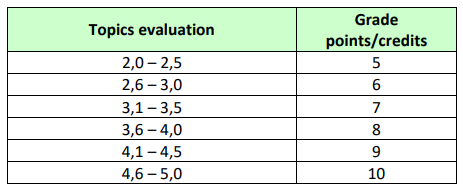
A student can obtain 10 credits (Table 3) throughout seminars and laboratory practicals after passing through 20 Topics (listed below). Evaluation of laboratory practicals implies a completed and accepted written report with all slides drawings. During laboratory practicals and seminars, the oral examination can be performed by the teacher or through short written exams.
Table 3. Evaluation of seminars and laboratory practicals
Topics T1 – Epithelial Tissue T2 – Connective Tissue, Blood, Cartilage, T3 – Bone, Osteogenesis, Bone Remodeling, Bone Marrow T4 – Muscle Tissue, Circulatory System T5 – Nerve Tissue, Nervous System T6 – Endocrine Glands T7 – Female Reproductive System, Gametogenesis, First Week of Development T8 – Second, Third Week of Development, Embryonic Period, Fetus, Fetal Membranes, Placenta, Twins T9 – Nervous System and Endocrine System Development T10 – Eye – Structure and Development T11 – Ear – Structure and Development 10 Other important information regarding to the course: T12 – Oral Cavity – Structure and Development, Teeth – Structure and Development T13 – Digestive Tract – Structure and Development T14 – Organ Associated with DT – Structure and Development T15 – Skin and Derivates – Structure and Development T16 – Immune System – Structure and Development T17 – Urinary System – Structure and Development T18 – Male Reproductive System – Structure and Development T19 – Respiratory System – Structure and Development T20 – Cardiovascular System – Development
Tissue section recognition
Is a compulsory oral exam and is required for students to be qualified for the final exam. A student must identify at least 10 of the 12 microscopic slides, as well as the structures that are described (and drawn) during the laboratory practicals, and can receive a maximum of 18 points. At least 9 points are required for passing the exam. Each slide is evaluated with ½, 1, or 1 ½ points depending on the student's knowledge. This exam will be held in the week before each final exam. At that time, the student can access the Tissue section recognition several times. Accurate dates and hours will be determined in agreement with the students.
Final exam
The final oral exam is mandatory and covers the entire course content. During the final exam, students can obtain a maximum of 30 credits. Assessment of the oral part of the final exam:
up to 15 credits: minimum criteria satisfied
16 – 20 credits: average criteria satisfied with noticeable errors
21 – 25 credits: answers with a few errors
26 – 30 credits: outstanding answers.
If a student is not satisfied with the final grade, they may refuse the grade. In case a student does not accept the grade, he/she must re-enter the final exam.
Conditions for admission to the final exam
A student who accomplishes 35 or more grade points during all course classes and/or after correction of the midterm exams, and passes Tissue section recognition with a minimum of 9 points can access the final exam.
A student who achieves less than 35 grade points during all course classes even after the correction of the midterm exams, or didn't achieve a minimum of 9 point on Tissue section recognition or is absent for more than 30% of all forms of classes, is graded as unsuccessful (F) and must re-enter the course.
Final grade
The final grade represents a sum of all grade points obtained during all course classes and on the final exam. Students are evaluated according to the ECTS (A-F) and numerical (5-1) system.
The ECTS and the numerical grading system are defined by the following criteria:
A (5) 90 – 100 credits
B (4) 75 – 89 credits
C (3) 60 – 74 credits
D (2) 50 – 59 credits
F (1) 0 – 49 credits
| Academic year | |
|---|---|
| 2021/2022 | [Download] |