Kolegij
Studiji
Medical Studies in EnglishStudijska godina
2ISVU ID
ECTS
5
Course aims, tasks, and learning outcomes
The aim of this course is to enable the student to apply previously acquired knowledge of Neuroanatomy and Physiology and Pathophysiology, and to acquire knowledge about the normal functioning of the nervous system, as well as knowledge about the pathophysiological mechanisms that lead to the disorders of the normal functioning and the occurrence of a specific disease.
Classes are held in the summer semester of the second year of study: 26 hours of lectures, 18 hours of seminars and 16 hours of practicals, which totals 5 ECTS. Immediately after held classes, two exam dates are planned. The objective of the course is to gain knowledge about the normal and disturbed functioning of the nervous system to the extent necessary for further successful study monitoring. The task of teaching is to acquire basic knowledge about the functional organization of the nervous system as a substrate of physiological and pathophysiological conditions, as well as to acquire knowledge about basic neurophysiological and neuropathological processes. Classes are performed in the form of lectures, seminars, and practicals, which include using computer programs like Biopack and SymBioSys that present physiological functions or certain diseases in humans, and program-oriented class. Certain pathological conditions are also demonstrated on animal models. Part of the seminars is conducted as a problem-oriented class so that students can solve physiological and pathophysiological problems with the help of the teacher based on typical anamnestic and diagnostic data.
At seminars and exercises, the student with the teacher actively discusses the physiological and pathophysiological mechanisms.
Course outline
General organization of the nervous system: central, peripheral, and autonomous; Neuronal cellular biology: microenvironment of a neuron – glial cells; Cerebral blood flow and its disorders; Blood-brain barrier and its disorders; Cerebrospinal fluid and hydrocephalus; General energy metabolism of the brain; Fundamental neurophysiological processes: membrane and action potentials; Emergence and spreading of the nerve impulse; Structure and function of synapses; Neurotransmitters and their receptors: biochemical features of synthesis and decomposition, distribution and interaction of neurotransmitter systems; Membrane receptors: division, structure, activation, distribution; pathophysiology of the nervous transmission; Neural circuits for information processing; Organization of sensory systems and sensory functions: somatic (receptors) and special senses (vision, hearing, balance, taste, smell); Sensory disorders, pathophysiological background of pain; General organization of the motor system: spinal and supraspinal reflexes; Pyramidal and extrapyramidal motor system; Basal ganglia function: cerebellar motoric control, motoric nervous disorders; Autonomic nervous system: physiological and pathophysiological aspects; General and managing brain functions: ascending reticular activation system (attention, vigilance, sleep); Limbic system (emotions, neuroendocrinology of behavior), sexuality; Higher brain functions: laminar and vertical organization of the cerebral cortex: integrative function of the nervous system; Intellectual functions (memory, thinking, speech); Mental function disorders.
Developing general competencies (knowledge and skills) At the end of this course, the student will be able to:
1. interpret and explain the basics of nervous system functioning
2. interpret and explain the basics of nervous system disorders
3. connect and determine the importance of the nervous system within the organism
Developing specific competencies (knowledge and skills)
At the end of this course, the student will be able to:
1. explain the principles of emergence and spreading of the action potential (impulse), as well as the basis for the pathophysiology of the nervous transmission
2. explain the concept of synaptic transmission, biochemical features of synthesis and decomposition, and distribution and interaction of neurotransmitter systems
3. list and describe the division, structure, distribution, and activation of membrane receptors
4. explain somatic (touch, pressure, position, pain, temperature) and special senses (vision, hearing, taste, smell, balance), from sensory receptors and input (afferent) fibers to the cerebral cortex
5. explain pathophysiological processes associated with damages to somatosensory and special senses
6. explain the role of the nervous system in motor control: organization of the motor unit, spinal motor system control, voluntary motor movements, posture, role of basal ganglia and small brain in motion control
7. explain the general and managing brain functions, states of vigilance and consciousness, emotions and mood
8. explain the reaction and importance of the autonomic nervous system
9. describe types of learning and memory, cellular learning and memory mechanisms, and learning and memory disorders
10. describe the structure and function of the blood-brain barrier, cerebrospinal fluid, blood flow regulation mechanisms and circulatory disorders (cerebrovascular insult)
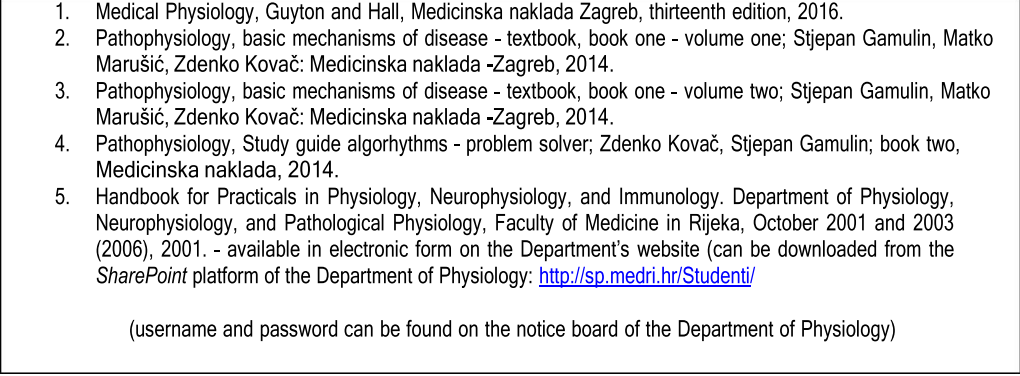

WARNING: students are required to bring with them to practicals: a) lab coat with b) Handbook for Practicals in Neurophysiology
Students ARE NOT ALLOWED to switch groups unless they find their replacements.
the student is obligated to prepare the material that is being discussed in seminars and practicals.
In accordance with the Law and Ordinance of the Faculty of Medicine in Rijeka, all forms of classes (lectures, seminars, and practicals) are mandatory. The validity of absence from seminars and practicals is proven by a valid certificate. Lectures, seminars, and practicals take place according to the Syllabus. Schedule of students by groups can be found on the SharePoint platform of the Department of Physiology and Immunology on the following website: https://spp.uniri.hr/ss_medri/katedre/427 - accessed via an AAI address.
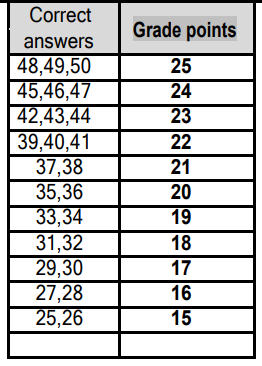
During the course, the aquired knowledge wil be evaluated by two midterm exams comprising 50 questions.
A student may obtain up to 25 grade points on each exam, as shown in the table
Each test has one corrective period for students who, for justified reasons, did not take the tests or did not collect the minimum number of points or are not satisfied with the number of points collected (then its previous result is deleted).
II. Final exam (up to 50 grade points)
Who can take the final exam: Students who have achieved 25 or more points during the course take the final exam where they can achieve a maximum of 50 points.
Who can NOT take the final exam: Students who have achieved less than 25 points during classes or were absent for more than 30% of classes do not have the right to take the final exam (re-enroll in the course of the next academic year).
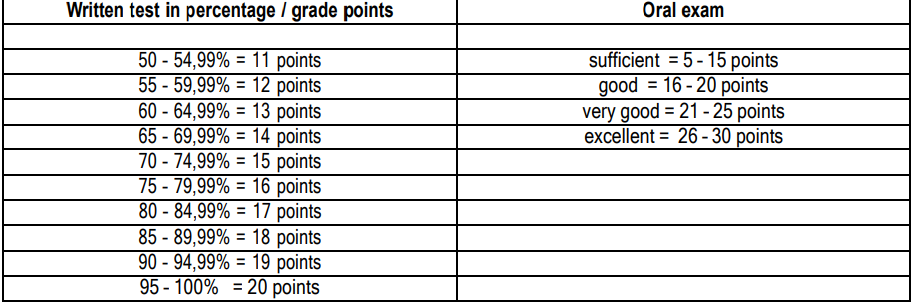
The final exam consists of a written and an oral part. The student must pass at least 50% of the written test comprising of 60 questions.at the final exam and be positively graded at the oral part of the exam.
The method of scoring in the final exam is shown in Table 2.
Grading in the ECTS system is done by absolute distribution, ie on the basis of the final achievement (points acquired during the course are added to the points from the final exam): A = 90 - 100% B = 75 - 89.9% C = 60 - 74.9% D = 50 - 59.9% F = 0 - 49.9%
Grades in the ECTS system are translated into a numerical system as follows: A = excellent (5) B = very good (4) C = good (3) D = sufficient (2) F = insufficient (1)
Other notes (related to the course) important for students: Teaching content and all information related to the course can be found on the Share-portal for internal communication of the Department of Physiology and Immunology.
IMPORTANT NOTE: If the epidemiological measures related to Covid-19 determine the ban on gathering students in large numbers at the faculty, we will adjust the INP and the method of assessment to the current situation. In that case, classes would be conducted online (via audio presentations, using the MS teams platform, etc.), and the writing of tests would be conducted via the Merlin system. Students will be notified in a timely manner of any changes to the INP. In addition, in accordance with the recommendations of the University of Rijeka, classes can be held in a hybrid, ie up to 40% of classes can be held online, and 60% or more regularly, ie in contact with students at the faculty.
Ishodi učenja
to describe the organization of the nervous system; to explain the main levels in the function of the central nervous system (CNS); to describe the cellular structure of neurons and glial cells; to describe the structure and function of synapses; to list types of synapses; to describe the physiological structure of synapses; to explain the role of calcium ions; to describe the function of receptor proteins on a postsynaptic neuron; to explain the transmission and signal processing in neuronal groups; to explain signal divergence and convergence and lateral inhibition; to explain the term reverberation, permanent signal output, and rhythmic signal output.
Ishodi učenja
to define the term neurotransmitter; to group low-molecular fast-acting transmitters; to group neuropeptide slow-acting transmitters; to describe the differences between these two groups of transmitters; to describe the procedures for identifying neurotransmitters and neuropeptides (according to Sheperd 1988); to describe the effects of neurotransmitters mediated through ionotropic or metabotropic postsynaptic receptors; to explain the term and meaning of receptor desensitization; to explain the glutamate metabolism in the brain; to describe the structure and function of NMDA and non-NMDA receptors; to explain the action mechanism of inhibitory GABA and glycine neurotransmitters; to describe the emergence and action of acetylcholine via acetylcholine receptors; to describe the emergence and action of monoamine neurotransmitters (dopamine, noradrenaline, and adrenaline) and serotonin; to describe the synthesis and processing of neuropeptides.
Ishodi učenja
to describe the membrane potential of soma neuron inaction: to repeat the ion concentrations on both sides of the neuron membrane; to define the term Nernst potential; to describe the role of diffusion and the Na/K pump in the emergence of the membrane potential of the nerve; to describe the emergence and all phases of the action potential of the nerve; to define the role of sodium and potassium channels regulated by voltage; to describe the law ‘all or nothing’; to explain the term saltatory impulse conduction in the nerves; to explain the emergence of excitatory and inhibitory postsynaptic potential; to describe the emergence of action potential on the axon of the neuron and the concept of threshold stimulus; to define the term presynaptic inhibition; to explain the term spatial and temporal neuron summation; to explain the term neuronal facilitation; to describe the terms "electronic current" and "decrementary" guidance along the dendrite towards the soma; to explain the synaptic transmission fatigue; to describe the effect of acidosis and alkalosis on the synaptic transmission; to describe the concept of synaptic decay.
Ishodi učenja
to group senses; to define sensory receptors; to group sensory receptors; to define the term sense modality and the principle of the "marked line"; to describe the emergence of receptor (generator) potential on the example of Pacinian corpuscle; to define the relationship between receptor and action potential; to describe the mechanisms of receptor adaptation; to explain the term "tonic" and "phasic" receptor; to describe the physiological classification and function of nerve fibers; to describe the relationship of tactile senses, pressure, and vibration; to describe tactile receptors; to describe the structure and function of sensory pathways for transmitting somatic signals into the central nervous system: 1. a dorsal column system – a medial lemniscus and anterolateral system 2; to describe the position, parts, and layers of the somatosensory cortex; to explain the functions of certain parts of the somatosensory cortex; to describe somatosensory homunculus; to define the position sense; to define the term dermatome.
Ishodi učenja
to describe the eye optics; to explain the formation and function of the intraocular fluid; to describe the structure of the retina; to explain the photochemistry of vision; to explain the phenomenon of adaptation and accomodation; to describe the visual pathway; to describe the contrast analysis in the visual image; to explain the method of determining the visual field; to describe eye movements and control over it; to describe the joining of visual images from both eyes;
Ishodi učenja
to explain nerve conduction disorders; to extract disorders of hypofunction and hyperfunction of dopamine, acetylcholine, serotonin neurotransmitters; to explain the emergence of Myasthenia gravis; to repeat the mechanism of desensitization; to describe the phenomenon of tardive dyskinesia, as well as the mechanism of abstinence crisis; to explain the concepts of denervation supersensitivity, hypoesthesia, paresthesia, as well as the concept of backward decay; to describe the anatomic isthmus syndrome; to define neuropathies and polyneuropathies; to describe the Brown-Sequard syndrome, conus and epiconus syndrome; to describe a thalamic syndrome; to describe phantom sensations; to define types of pain; to describe pain receptors; to describe twice for pain: the neospinothalamic tract and paleospinothalamic tract; to describe the functions of reticular formation, thalamus, and cerebral cortex in pain perception; to describe the analgesic system in the brain and the spinal cord; to explain the importance of the opiate system in the brain; to explain the term reflected and visceral pain; to describe and list types of headaches.
Ishodi učenja
to describe the physiological structure of the cerebral cortex; to describe the thalamocortical system; to explain the functions of specific cortical areas: association areas: parietal-occipital-temporal, prefrontal, and limbic association area; to explain the position and meaning of the Wernicke area; to explain the notion of a dominant hemisphere; to explain the significance of a non-dominant hemisphere; to describe the brain function in communication (speech); to name and describe types of speech disorders; to describe the significance of the corpus callosum; to define the notion of thought, consciousness, and memory; to explain the concept of positive and negative memory; to group memory; to describe the mechanism of short-term, medium-long and long-term memory emergence; to describe the memory consolidation phenomenon: the role of the hippocampus in the process of memory.
Ishodi učenja
to describe two types of sleep; to explain basic theories of sleep; to describe the emergence and origin of brain waves; to distinguish epilepsies; to define schizophrenia, Alzheimer's disease, and dementia; to describe parts of the limbic system and the activation-stimulating brain system; to describe the functions of the hypothalamus; to explain the importance of reward and punishment in behavior; to describe the functions of the hippocampus and the amygdala
Ishodi učenja
to define three types of motor abilities: voluntary, subconscious, and reflexive; to describe the structure of the spinal cord; to describe the function of alpha and gamma motoneurons, interneurons, Renshaw's cells;to describe the structure of the muscle spindle and the sensory and motor innervation of the spindle; to explain the receptor function of the muscle spindle; to describe the reflex arc; to describe the reflex to stretch (dynamic and static part of the reflex); to describe the importance of control of the gamma-motor system; to describe the term clonus; to describe Golgi's tendon reflex; to describe the polysynaptic flexor reflex; to explain the removal pattern; to describe the crosslinked extensor reflex; to define the term reciprocal inhibition; to describe the reflex for body posture and walk; to describe the spinal shock
Ishodi učenja
to define the position and functional parts of the motor cortex; to describe the motor homunculus; to extract specialized motor control areas; to define the medial and lateral motor system; to describe the corticospinal tract; to describe other neural pathways leaving the motor cortex; to describe the input pathways in the motor cortex; to describe the corticospinal tract; to describe the structure and function of cerebral cortex neuron pillars; to describe the stimulation of the spinal cord motoneurons; to describe the role of brainstem in the control of the motor function – the role of reticular and vestibular nuclei (to describe reticulospinal and vestibulospinal tracts); to describe the position and the anatomical and functional parts of the small brain; to define the input tracts into the small brain; to describe the deep nuclei and output tracts of the small brain; to describe the functional unit of the small brain cortex; to describe the parts and function of vestibulocerebellum; to describe the parts and function of spinocerebellum; to describe the parts and function of the cerebrocerebellum; to describe clinical disorders of the small brain.
Ishodi učenja
to name basal ganglia; to describe the putamen circuit; to describe the caudate circuit; to explain the function of neurotransmitters in the basal ganglia system; to explain the emergence of Parkinson's disease; to explain the emergence and clinical image of Huntington's disease; to explain the formation of athetosis and hemiballism; to explain the functional connection of the basal ganglia with the brainstem and the motor cortex; to describe the basics of motor neural disorders; to describe the consequences of damage to the corticospinal tract; to describe cerebellar control disorders; to describe disorders of neuromuscular junction (Myasthenia gravis); to describe peripheral motoneuron disorders; to describe motor unit disorders.
Ishodi učenja
to describe the general organization of ANS; to describe the structure of the sympathetic nervous system: preganglionic and postganglionic neurons; to describe the organization of the parasympathetic nervous system: preganglionic and postganglionic neurons; to describe cholinergic and adrenergic fibers; to describe adrenergic and cholinergic receptors and their functions; to describe the effects of sympathetic and parasympathetic stimulation of certain organs: the eye, the glands, the digestive system, the heart, the blood vessels, the blood pressure; to describe the function of the adrenal gland medulla; to explain sympathetic and parasympathetic tone; to describe autonomous reflexes; to describe the alarming reaction of the sympathetic system; to describe ANS control; to name the etiological factors of the neurovegetative disorder; to explain the concepts of primary and secondary ANS disorders; to describe disorders of circadian rhythms; to describe sleeping disorders - awakeness; to explain the concept of psychosomatic disease; to describe chronic fatigue syndrome.
Ishodi učenja
to describe the circle of Willis; to explain the role of the perivascular space; to describe the structure of the blood-brain barrier; to explain the function of the blood-brain barrier; to describe the specificities of the brain microcirculation; to discuss transmission through the blood-brain barrier; to describe the regulation of the cerebral blood flow: autonomous and nervous; to explain the emergence and the clinical image of a stroke (ischemic and hemorrhagic); to describe the cerebral metabolism; to describe the cerebrospinal fluid system: formation, flow, and absorption of the cerebrospinal fluid; to explain the function of the cerebrospinal fluid; to describe the composition of the cerebrospinal fluid; to describe the blood-cerebrospinal fluid barrier; to describe the emergence of the communicating and non-communicating hydrocephalus; to describe the functions of the ependyma; to name and define the functions of circumventricular organs
Ishodi učenja
to describe the membrane and action potential; to describe the skeletal muscle contraction; to describe the structure and function of the neuromuscular junction; to describe the effect of strychnine on the spinal cord; to explain the term and meaning of electromyography; to describe the concept of muscular fatigue.
Practical part: EMG1- Biopac video recordings showing the dependence of the electric current voltage and the frequency of stimulation on the muscle contractions in rats (continuous amplification of the stimulation until tetany) - neuromuscular connection strychnine
For this practical class, students should prepare the following material: from the textbook A. C. Guyton and Hall, Medical Physiology, Chapter 5. Membrane Potentials and Action Potentials; Chapter 6. Contraction of Skeletal Muscle; Chapter 7. Excitation of Skeletal Muscle: Neuromuscular Transmission and Excitation-Contraction Coupling and from the Handbook for Practicals in Physiology, Neurophysiology and Immunology, Rijeka, 2001, exercises number 25, 28 and 29
Ishodi učenja
to examine eye movements and to describe control over it; to perform pupillary reflex; to perform a corneal reflex; to determine visual acuity; to examine color recognition; to determine the width of the visual field by the perimeter method; to perform the optokinetic test, to describe the concept of visual fixation.
Practical part: Eye: 1.) Determining visual acuity; 2.) Color recognition; 3.) Reflex reactions; 4.) Ocular motility; 5.) Perimetry (visual field examination); 6.) Fundus in rats; 7.) Optokinetic record.
The student is expected to be prepared for this practical based on the previously acquired knowledge from the lecture. The student should prepare the following material: from the textbook A. C. Guyton and Hall, Medical Physiology, Chapter 50. The Eye I: Optics of Vision; Chapter 51. The Eye II: Receptor and Neural Function of the Retina; Chapter 52: The Eye III: Central Neurophysiology of Vision and from the Handbook for Practicals in Physiology, Neurophysiology and Immunology, Rijeka, 2001, exercises number 31 and 32.
Ishodi učenja
to examine the hearing with a tuning fork; to examine the sense of balance; to examine the excitability of the vestibular system; to examine senses of taste and smell.
Practical part: A. Ear: 1) A sense of hearing; 2) Functional tests of balance organs B. Taste: 1) Testing the sense of taste for sour, salty and bitter (clinical application) C. Smell: 1) Measuring smell by Bornstein
The student should prepare the following material: from the textbook A. C. Guyton and Hall, Medical Physiology, Chapter 53. The Sense of Hearing; Chapter 54. The Chemical Senses – Taste and Smell; Chapter 56. Vestibular Sensations (p. 714-719) and from the Handbook for Practicals in Physiology, Neurophysiology, and Immunology, Rijeka, 2001, exercises number 33, 34, 35 and 36
Ishodi učenja
to describe the term decerebration; to explain the EEG method; to repeat the motor function of the spinal cord (spinal reflexes); to repeat the role of the cerebral crotex and brainstem over motor functions; to repeat the role of the small brain and basal ganglia in the motor; to repeat brain activity states: waves, sleep, epilepsies.
Practical part studying spinal reflexes in humans, motor function of the brainstem, basal ganglia, and medulla spinalis, retucilar activation system, cerebral cortex, video recordings, decerebration, syptoms of epiletpsy
The student should prepare the following material from the textbook A.C. Guyton and Hall, Medical Physiology, Chapter 55 Motor Functions of the Spinal Cord, the Cord Reglexes; Chapter 56; Cortical and Brain Stem Control of Motor Function; Chapter 57: Contributions of the Cerebellum and Basal Gnaglia to Overall Motor Control and from the Handbook for Practicals in Physiology, Neurophysiology and Immunology, Rijeka, 2001, execrises number 24, 26, 27 and 30.
Ishodi učenja
to group cells of the nervous system; to describe the structure and fuction of neurons; to describe the structure and function of glial cells; to describe the parts and function of central and peripheral synapses; to describe the process of neurotransmitter exocytosis; to describe the activation of ionotripic receptors; to describe the term EPSP and IPSP; to describe synthesis, action, and decomposition of acetylcholine; to describe the effects of certain medicaments and drugs on the neuromuscular junction.
Literature:
Chapter 46. Organization of the Nervous System, Basic Function of Synapses, Electrical Events during Neuronal Excitation
Textbook: Medical Physiology, Guyton and Hall
Ishodi učenja
sensory receptors; sensory pathways for the transmission of somatic signals; somatic sensations.
Literature:
Chapter 47. Sensory receptors
Chapter 48. Somatic Sensation: General Organization, The Tactile and Position Senses Textbook: Medical Physiology, A.C. Guyton and Hall
Ishodi učenja
to repeat the physical principles of optics; to describe the eye optics; to explain the notion of visual acuity; to explain the formation and function of the intraocular fluid; to describe the structure of the retina; to explain the photochemistry of vision; to explain the phenomenon of adaptation and accommodation.
Literature:
Chapter 50. The Eye I: Optics of Vision
Chapter 51. The Eye II: Receptor and Neural Function of the Retina
Chapter 52. The Eye: III. Central Neurophysiology of Vision
Textbook: Medical Physiology, Guyton and Hall
to explain the phenomenon of color vision; to describe the neural function of the retina and all of its cells; to explain the phenomenon of lateral inhibition in the visual signal transmission; to describe the visual pathway; to describe the contrast analysis in the visual image; to explain the method of determining the visual field; to describe eye movements and control over it; to describe the joining of visual images from both eyes;
Ishodi učenja
to describe the anatomical structure of the outer, middle, and inner ear; to explain the mechanism of impedance adaptation using the ossicle system; to describe the "traveling wave"; to describe the function of the organ of Corti; to explain the phenomenon of sound frequency determination (principle of place); to describe the determination of sound volume; to describe the auditory nerve pathway; to understand the role of the auditory cortex; to name hearing disorders; to define types of flavor; to describe the structure and function of the taste bud; to describe taste pathways; to describe the sense of smell: types, signal transmission into the nervous system; to describe the structure and function of the vestibular apparatus.
Literature:
Chapter 53. The Sense of Hearing
Chapter 54. The Chemical Senses – Taste and Smell Chapter 56. Vestibular Sensations (p. 714-719)
Textbook: Medical Physiology, Guyton and Hall
Ishodi učenja
to describe the parts and function of the association areas; to describe all intellectual brain functions (communication, thought, consciousness, memory); to describe the mechanisms of short-term, medium-long, and long-term memory emergence; to describe the excitatory-activating system of the brain; to describe the parts and function of the limbic system (hypothalamus, hippocampus, amygdala, limbic cortex); to describe stages of sleep; to repeat the basic theories of sleep; to define types of brain waves; to describe epilepsies; to define depression, schizophrenia, and Alzheimer's disease. Literature:
Chapter 58. Cerebral Cortex, Intellectual Functions of the Brain, Learning, and Memory
Chapter 59. Behavioral and Motivational Mechanisms of the Brain – The Limbic System and the Hypothalamus
Chapter 60. State of Brain Activity – Sleep, Brain Waves
Textbook: Medical Physiology, Guyton and Hall
Ishodi učenja
define the structure of the motor system; motor functions of the spinal cord and brainstem; cortical and cerebellar control of motor functions and the contribution of basal ganglia to motor control.
Literature:
Chapter 55. Motor Functions of the Spinal Cord; the Cord Reflexes
Chapter 56. Cortical and Brain Stem Control of Motor Function
Chapter 57. Contributions of the Cerebellum and Basal Ganglia to Overall Motor control
Textbook: Medical Physiology, A.C. Guyton and Hall
| Akademska godina | |
|---|---|
| 2023/2024 | Download |