Course
Study programs
Medical Studies in EnglishYear of study
2ISVU ID
ECTS
2
The course “Medical ethics” is a second-year compulsory course of the Integrated Undergraduate and Graduate University Study of Medicine in English. The course consists of 15 hours of lectures and 30 hours of seminars. 2 ECTS credits are gained after successful completion of the course. The course is held in the third semester. The students are organized in one group for the seminars, which is in coordination with other courses during the third semester. The course is held within the Department of Social Sciences and Medical Humanities, Faculty of Medicine, University of Rijeka, Braće Branchetta 20, Rijeka.
Course content:
TOPICS OF THE LECTURES:
- Introductory lecture; Medical ethics and bioethics
- Bioethical declarations and their meaning
- The emergence and development of bioethics, bioethics in Croatia
- Ethical theories and bioethical principles, Code of medical ethics and dentology
- Privacy and confidentiality in the doctor/patient relationship
- Paternalism
- Informed consent
- Communication in ethically challenging situation
- Organ transplantation
- Vulnerable groups
- Reproduction
- Abortion
- Euthanasia and palliative medicine
- Vaccination
- Appeal of consciences
THE SEMINAR TOPICS:
- Presentation of seminar topics, students' selection of the topics, guidelines for writing the seminar paper, schedule for students' oral presentations of seminar papers
- Analysis of documents
- The birth of bioethics; analysis of fundamental events in the history of bioethics
- Ethical theories and bioethical principles
- Privacy and confidentiality
- Paternalism
- Informed consent
- Communication in ethically challenging situation
- Organ transplantation
- Vulnerable groups
- Reproduction
- Abortion
- Euthanasia and Palliative medicine
- Vaccination
- Appeal of consciences
- Test in the term of seminar 16 – the exact date and time will be decided later
Teaching is performed:
Teaching is held in the forms of lectures and seminars throughout the 3rd semester. Lectures (15 L) – classical lectures with the possibilities of students' inclusion; acquisition of theoretical knowledge and information based on examples. Seminars (30 S) – interactive teaching based on examples with the discussion, seminar assignments, case discussion, oral presentation and writing papers - optional. The teacher who participate in the course: associate professor.Gordana Pelčić, full professor Amir Muzur, associate professor Iva Rinčić, assistant professor Igor Eterović, PhD Robert Doričić, Gordana Šimunković, assistant, Toni Buterin, assistant. The collaborators in the course: associate professor Nataša Vlah, full professor Florian Steger.
Lectures presentations
Materials for seminars
Bioethical documents / The Code of Medical Ethics and Deontology
1.LooseLeaf for Medical Ethics: Accounts of Ground-Breaking Cases
2. Principles of Biomedical Ethics.
3. Clinical Ethics, 8th Edition: A Practical Approach to Ethical. Decisions in Clinical Medicine.
4. A Short History of Medical Ethics
5. Medical Ethics and Humanities. https://www.amazon.com/Medical-Ethics-HumanitiesFrederick-Adolf/dp/07637606
6. Medical Humanities: An Introduction.
7. https://www.amazon.com/Medical-Humanities-Introduction-Thomas-Cole/dp/110761
8. Medicine and Medical Ethics in Nazi Germany: Origins, Practices, Legacies
9. Case Studies in Biomedical Ethics: Decision-Making, Principles, and Cases (https://www.amazon.com/Case-Studies-Biomedical-Ethics-Decision-Making/
10. Medical Ethics: A Very Short Introduction* -
11. https://www.amazon.com/Medical-Ethics-Very-Short-Introduction/dp/01928
12. Medical Review Aushwiths:Medicine Behind the Barbed Wire-Conference Proceedings 2018, Medycyny Praktyczna, Polski institytut Evidence Based Medicine 2019 KrakÓw Poland.
Lecture presentation and some other papers will be hend out to the students during the class. The literature will be available in the library of Faculty of Medicine.
Regular class attendance (lectures and seminars)
Being active in the classes Colloquium (the midterm exam)
Preparation and oral presentation of seminar paper
The final exam
ECTS Grading System:
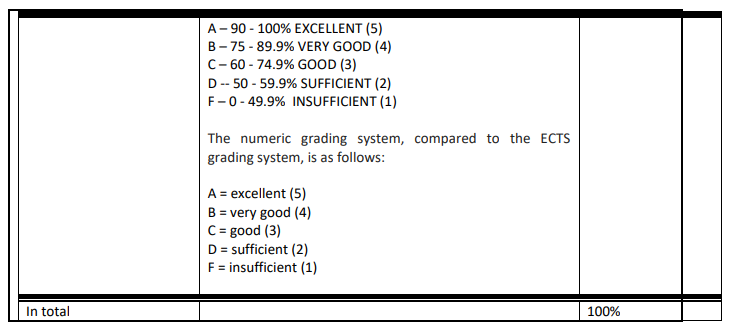
Student grading will be conducted according to the current Ordinance on Studies of the University of Rijeka (approved by the Senate) and the Ordinance on Student Grading at the Faculty of Medicine in Rijeka (approved by the Faculty Council). Student's work will be assessed and graded during the course and on the final exam. A student may achieve up to 50% of the grade during the course, and up to 50% of the grade on the final exam. Students are graded according to the ECTS credit (A-F) and numeric (1-5) system.
Students are obliged to attend all forms of teaching during the course and may be absent from 30% of the classes. In case of absence from more than 30% of the classes, students have failed the course. In addition, a student who has achieved less than 30 points during the classes must retake the course. From the maximum of 50 points during the classes, student must achieve 25 points to be allowed to take the final exam
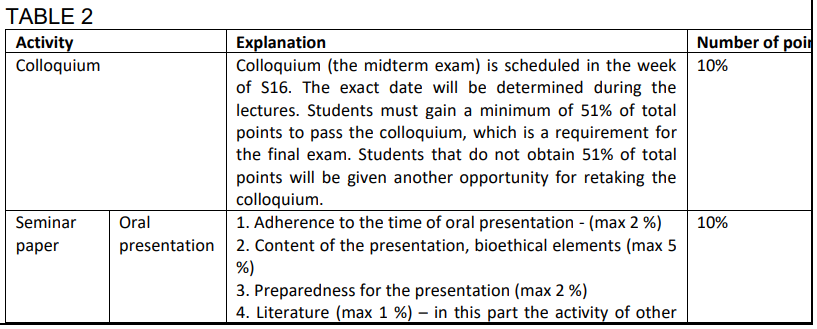
The students gain score points with an active participation in classes, performing the tasks and passing the colloquium (midterm exam):
During the classes the following is evaluated (up to 50 points) (for details see table 2):
Activity in the classes – max 10%
Working shits -max 15%
The colloquium (midterm exam) - max 10%
The design and presentation of the seminar topic with discussion - max 15% (presentation 10%, discussion 5%)
The final exam - max 50%
On the final exam can be realized maximum 50 points. There are no negative points on the final exam. The requirement for passing the final exam is 50% of the correct answers. All questions on the final exam are based on the materials covered in class and written materials. The condition for approaching the final exam are: regular attendance of the classes with maximum of 15 hour absence (Lectures and seminars), completed colloquium, passed oral presentation of seminar topic (minimum gained points 10%)
It is no possible to refuse the obtained grade in the course of Medical ethics according to the Regulation of the studies University of Rijeka article 46. Student can make objection to the Dean of the Faculty of Medicine Rijeka during the 25 hours.


Attendance of the class
The student's attendance will be checked at the beginning of each class. A student coming to class late may attend lecture, but will not get any points. It is not allowed to use mobile phones in the class.
Written paper work
- Students will decide regarding the submition of the written seminar paper regarding the possibilities of gainng 3 extra points. .
- Academic rectitude
- Teaching staff and students are obligated to respect academic rectitude.
- Contact with the teaching staff
- Contact with the teaching staff is in person or via email.
- Expected general competencies
- No specific general competencies are needed for enrolling in this class. It is expected that student is able to use computer, to search the web, or to communicate in English language.
Seminar topics:
- The history of medical ethics and bioethics
- Nazi medicine and the Nuremberg trials
- Content and meaning of the Nuremberg code
- The Declaration of Helsinki
- Medical ethics and society
- The role of media in medical ethics
- Medical ethics: from professionalism to the business ethics
- Drug addiction treatment and responsibility of society
- Societhical category of health: obesity
- Societhical category of health: genetic predisposition
- Big data in medicine
Medical ethics and mental health
- Ethical issues in the treatment of patients with mental illness
- Suicide – from particular case to a society problem
- Mental health and psychopharmacology
Bioethics in Croatia and the World
- Integrative bioethics
- The role of the Council of Europe in bioethics – Convention on Human Rights and Biomedicine
- European principles in bioethics
- The National Committee for Medicine (legal, ethical protocol, members…)
Ethical issues regarding the end of life
- The history of death perception in different cultures
- Pain as an ethical issue
- Palliative medicine
- Distanasia
Ethical issues regarding the beginning of life
- Surrogate motherhood
- Ethical issues regarding the procedures and consequences of sex selection of the child
- Genetic counseling, right to know and right to not-know
- Therapeutic cloning as an ethical issue
- Reproductive cloning as an ethical issue
- Feminist (bio)ethic and the beginning of life
Research ethics
- Ethical issues regarding the research with animals
- Ethical issues regarding the research with children
- Ethical issues regarding the research on stem cells
- Ethical issues regarding the research with incompetent subjects
- Ethical issues regarding the research in the “third world country”
- Doctor – scientist: ethical similarities and differences
Medicine, ethics, religion
- Islam as a basis for deontological activity in bioethics
- Christian ethics and holiness of life in the comptemporary bioethical discussions
- Jehovah's witnesses and blood transfusions
- Scientology and medical treatment
- Alternative medicine in contemporary society
New theologies
- Social networks and health
- The role of media in healthcare education
- Internet addiction
Other topics
- Communication with deaf patients
- Ethical challenges in cosmetic surgery
- Ethical dilemmas in xenotransplantation
- Bioethical aspects of vaccination hesitancy
- Ethical and legal aspects of sex change
- Organ transplantation
- GMO – from chance to threat
- Disabilities from medical to social category
- Hans Jonas’ Ethics of Responsibility
- Triage in medicine – possible ethical issues?
- The role of media in processing the delicate themes
- Ethic committees
- How to improve the teaching of medical ethics in the 21st century?
- Reproductive technologies in demographic problems
- Ethical responsibilities for our own health
- Culture and pain
- Commercialization of reproduction
- Genetic testing and disabilities
- Vaccination
The final list of seminar topics will be available at the beginning of the course.
Learning outcomes
- Define fundamental ethical terms; ethical theories, their division and main representatives; theories, principles, ethical approaches to particular topics
- Describe fundamental terms: Ethics, moral, bioethics, ethical theories, principles, ethical approaches to particular topics
- Differentiate fundamental approaches within ethical theories and their main characteristics
- Explain moral norms within health care system
- Specify, recognize and explain fundamental terms of particular content units (i.e. anthropocentrism, biocentrism, responsibility, interdisciplinarity, pluriperspectivity, paternalism etc.)
- Describe and compare basic ethical issues in contemporary bioethical topics
- Apply ethical theories and principles to particular cases of medical and clinical practice
Learning outcomes
- Define fundamental ethical terms; ethical theories, their division and main representatives; theories, principles, ethical approaches to particular topics
- Describe fundamental terms: Ethics, moral, bioethics, ethical theories, principles, ethical approaches to particular topics
- Differentiate fundamental approaches within ethical theories and their main characteristics
- Explain moral norms within health care system
- Specify, recognize and explain fundamental terms of particular content units (i.e. anthropocentrism, biocentrism, responsibility, interdisciplinarity, pluriperspectivity, paternalism etc.)
- Describe and compare basic ethical issues in contemporary bioethical topics
- Apply ethical theories and principles to particular cases of medical and clinical practice
Learning outcomes
- Define fundamental ethical terms; ethical theories, their division and main representatives; theories, principles, ethical approaches to particular topics
- Describe fundamental terms: Ethics, moral, bioethics, ethical theories, principles, ethical approaches to particular topics
- Differentiate fundamental approaches within ethical theories and their main characteristics
- Explain moral norms within health care system
- Specify, recognize and explain fundamental terms of particular content units (i.e. anthropocentrism, biocentrism, responsibility, interdisciplinarity, pluriperspectivity, paternalism etc.)
- Describe and compare basic ethical issues in contemporary bioethical topics
- Apply ethical theories and principles to particular cases of medical and clinical practice
Learning outcomes
- Define fundamental ethical terms; ethical theories, their division and main representatives; theories, principles, ethical approaches to particular topics
- Describe fundamental terms: Ethics, moral, bioethics, ethical theories, principles, ethical approaches to particular topics
- Differentiate fundamental approaches within ethical theories and their main characteristics
- Explain moral norms within health care system
- Specify, recognize and explain fundamental terms of particular content units (i.e. anthropocentrism, biocentrism, responsibility, interdisciplinarity, pluriperspectivity, paternalism etc.)
- Describe and compare basic ethical issues in contemporary bioethical topics
- Apply ethical theories and principles to particular cases of medical and clinical practice
Learning outcomes
- Define fundamental ethical terms; ethical theories, their division and main representatives; theories, principles, ethical approaches to particular topics
- Describe fundamental terms: Ethics, moral, bioethics, ethical theories, principles, ethical approaches to particular topics
- Differentiate fundamental approaches within ethical theories and their main characteristics
- Explain moral norms within health care system
- Specify, recognize and explain fundamental terms of particular content units (i.e. anthropocentrism, biocentrism, responsibility, interdisciplinarity, pluriperspectivity, paternalism etc.)
- Describe and compare basic ethical issues in contemporary bioethical topics
- Apply ethical theories and principles to particular cases of medical and clinical practice
Learning outcomes
- Define fundamental ethical terms; ethical theories, their division and main representatives; theories, principles, ethical approaches to particular topics
- Describe fundamental terms: Ethics, moral, bioethics, ethical theories, principles, ethical approaches to particular topics
- Differentiate fundamental approaches within ethical theories and their main characteristics
- Explain moral norms within health care system
- Specify, recognize and explain fundamental terms of particular content units (i.e. anthropocentrism, biocentrism, responsibility, interdisciplinarity, pluriperspectivity, paternalism etc.)
- Describe and compare basic ethical issues in contemporary bioethical topics
- Apply ethical theories and principles to particular cases of medical and clinical practice
Learning outcomes
- Define fundamental ethical terms; ethical theories, their division and main representatives; theories, principles, ethical approaches to particular topics
- Describe fundamental terms: Ethics, moral, bioethics, ethical theories, principles, ethical approaches to particular topics
- Differentiate fundamental approaches within ethical theories and their main characteristics
- Explain moral norms within health care system
- Specify, recognize and explain fundamental terms of particular content units (i.e. anthropocentrism, biocentrism, responsibility, interdisciplinarity, pluriperspectivity, paternalism etc.)
- Describe and compare basic ethical issues in contemporary bioethical topics
- Apply ethical theories and principles to particular cases of medical and clinical practice
Learning outcomes
- Define fundamental ethical terms; ethical theories, their division and main representatives; theories, principles, ethical approaches to particular topics
- Describe fundamental terms: Ethics, moral, bioethics, ethical theories, principles, ethical approaches to particular topics
- Differentiate fundamental approaches within ethical theories and their main characteristics
- Explain moral norms within health care system
- Specify, recognize and explain fundamental terms of particular content units (i.e. anthropocentrism, biocentrism, responsibility, interdisciplinarity, pluriperspectivity, paternalism etc.)
- Describe and compare basic ethical issues in contemporary bioethical topics
- Apply ethical theories and principles to particular cases of medical and clinical practice
Learning outcomes
- Define fundamental ethical terms; ethical theories, their division and main representatives; theories, principles, ethical approaches to particular topics
- Describe fundamental terms: Ethics, moral, bioethics, ethical theories, principles, ethical approaches to particular topics
- Differentiate fundamental approaches within ethical theories and their main characteristics
- Explain moral norms within health care system
- Specify, recognize and explain fundamental terms of particular content units (i.e. anthropocentrism, biocentrism, responsibility, interdisciplinarity, pluriperspectivity, paternalism etc.)
- Describe and compare basic ethical issues in contemporary bioethical topics
- Apply ethical theories and principles to particular cases of medical and clinical practice
Learning outcomes
- Define fundamental ethical terms; ethical theories, their division and main representatives; theories, principles, ethical approaches to particular topics
- Describe fundamental terms: Ethics, moral, bioethics, ethical theories, principles, ethical approaches to particular topics
- Differentiate fundamental approaches within ethical theories and their main characteristics
- Explain moral norms within health care system
- Specify, recognize and explain fundamental terms of particular content units (i.e. anthropocentrism, biocentrism, responsibility, interdisciplinarity, pluriperspectivity, paternalism etc.)
- Describe and compare basic ethical issues in contemporary bioethical topics
- Apply ethical theories and principles to particular cases of medical and clinical practice
Learning outcomes
- Define fundamental ethical terms; ethical theories, their division and main representatives; theories, principles, ethical approaches to particular topics
- Describe fundamental terms: Ethics, moral, bioethics, ethical theories, principles, ethical approaches to particular topics
- Differentiate fundamental approaches within ethical theories and their main characteristics
- Explain moral norms within health care system
- Specify, recognize and explain fundamental terms of particular content units (i.e. anthropocentrism, biocentrism, responsibility, interdisciplinarity, pluriperspectivity, paternalism etc.)
- Describe and compare basic ethical issues in contemporary bioethical topics
- Apply ethical theories and principles to particular cases of medical and clinical practice
Learning outcomes
- Define fundamental ethical terms; ethical theories, their division and main representatives; theories, principles, ethical approaches to particular topics
- Describe fundamental terms: Ethics, moral, bioethics, ethical theories, principles, ethical approaches to particular topics
- Differentiate fundamental approaches within ethical theories and their main characteristics
- Explain moral norms within health care system
- Specify, recognize and explain fundamental terms of particular content units (i.e. anthropocentrism, biocentrism, responsibility, interdisciplinarity, pluriperspectivity, paternalism etc.)
- Describe and compare basic ethical issues in contemporary bioethical topics
- Apply ethical theories and principles to particular cases of medical and clinical practice
Learning outcomes
- Define fundamental ethical terms; ethical theories, their division and main representatives; theories, principles, ethical approaches to particular topics
- Describe fundamental terms: Ethics, moral, bioethics, ethical theories, principles, ethical approaches to particular topics
- Differentiate fundamental approaches within ethical theories and their main characteristics
- Explain moral norms within health care system
- Specify, recognize and explain fundamental terms of particular content units (i.e. anthropocentrism, biocentrism, responsibility, interdisciplinarity, pluriperspectivity, paternalism etc.)
- Describe and compare basic ethical issues in contemporary bioethical topics
- Apply ethical theories and principles to particular cases of medical and clinical practice
Learning outcomes
- Define fundamental ethical terms; ethical theories, their division and main representatives; theories, principles, ethical approaches to particular topics
- Describe fundamental terms: Ethics, moral, bioethics, ethical theories, principles, ethical approaches to particular topics
- Differentiate fundamental approaches within ethical theories and their main characteristics
- Explain moral norms within health care system
- Specify, recognize and explain fundamental terms of particular content units (i.e. anthropocentrism, biocentrism, responsibility, interdisciplinarity, pluriperspectivity, paternalism etc.)
- Describe and compare basic ethical issues in contemporary bioethical topics
- Apply ethical theories and principles to particular cases of medical and clinical practice
Learning outcomes
- Define fundamental ethical terms; ethical theories, their division and main representatives; theories, principles, ethical approaches to particular topics
- Describe fundamental terms: Ethics, moral, bioethics, ethical theories, principles, ethical approaches to particular topics
- Differentiate fundamental approaches within ethical theories and their main characteristics
- Explain moral norms within health care system
- Specify, recognize and explain fundamental terms of particular content units (i.e. anthropocentrism, biocentrism, responsibility, interdisciplinarity, pluriperspectivity, paternalism etc.)
- Describe and compare basic ethical issues in contemporary bioethical topics
- Apply ethical theories and principles to particular cases of medical and clinical practice
| Academic year | |
|---|---|
| 2023/2024 | [Download] |