Course
Study programs
Medical Studies in EnglishYear of study
2ISVU ID
ECTS
4
The main aim of this course is to introduce students to the normal and pathological function of the immune system. The focus is on the explanation of physiological processes that enable normal functioning of certain subtypes of immune cells in a non-specific and specific immune response, as well as on the explanation of pathophysiological mechanisms leading to disorders of normal immune processes, as well as on the possibilities for therapeutic action to the immune response. Teaching tasks imply enabling the student to connect basic knowledge of immunology and pathophysiology of the immune system with the teaching of physiology and pathophysiology, microbiology and parasitology, pathology, infectious disease, oncology, and epidemiology (vaccination), therefore, qualifying the student to apply immunological cognition in clinical medicine.
Course content:
Overview of Immunity. Antigens. Tissue Cells and Organs of the Immune System. Major Histocompatibility Complex Molecules. Immune Recognition. Cellular Immunity. Non-specific Immunity. Complement. Structure of Antibody and Antigen Receptor of Lymphocyte B. Gene Background of Synthesis and Antibody Differences. Humoral Immunity. Immune Response Regulation. Interaction of Immune Cells. Action on Immune Response. Cytokines and Chemokines. Immune Response to Tumor. Immunodeficiency and AIDS. Immunotolerance and Autoimmunity. Immunity to Infections. Tissue and Organ Transplantation. Immunological Hypersensitivity. Mucosal Immunity. Vaccination. Laboratory Methods in Clinical Immunology.
Class organization:
Class attendance is mandatory. The course consists of 24 hours of lectures, 18 hours of seminars, and 8 hours of practicals, which totals 50 class hours. Students are obligated to wear lab coats during practicals and have exercise protocols, where they will write measured and obtained values. Throughout seminars and practicals, the student actively discusses immune mechanisms with the lecturer. The student is obligated to prepare the material that is being discussed in seminars and practicals. The teacher evaluates student participation throughout seminars and practicals (demonstrated knowledge, understanding, the ability to set up a problem, concluding, etc.). There will be two midterm exams during the course, and a written and an oral part of the final exam at the end of classes. After completing all class activities and the final exam, the student acquires 4 ECTS credits.
- Abbas A.K, Lichtman A.H., Pillai S. Cellular and Molecular Immunology. International Edition. Tenth edition. Elsevier, 2021. or Abbas A.K, Lichtman A.H., Pillai S. Cellular and Molecular Immunology. International Edition. Eighth edition. Elsevier, 2015.
- Handbook for Practicals in Immunology, Editor: H. Mahmutefendić. The University of Rijeka, Faculty of Medicine, 2014. (e-edition), 2015 (printed edition).
- Abbas A.K, Lichtman A.H., Pillai S. Basic Immunology. Functions and Disorders of the Immune System. Fifth edition. Elsevier, 2016.
- Murphy K, Weaver C: Janeway's Immunobiology 9th edition, Garland Science, New York and London, 2017.
ECTS grading system
Student grading will be conducted according to the current Ordinance on Studies of the University of Rijeka and the Ordinance on Student Grading at the Faculty of Medicine in Rijeka. Student work and achievement are assessed and graded during the course, which is the basis for the final grade. Student work and competencies are evaluated during classes with a maximum of 70-grade points and up to 30- grade points at the final exam, which totals 100-grade points. Students are graded according to the ECTS (A-E) and numerical system (1-5). Grading, according to the ECTS system, is conducted according to the absolute redistribution, as well as according to the graduate grading criteria.
I. The following components are evaluated during the course (maximum of 70-grade points):
1) Attendance (up to 6-grade points)
Attendance at all forms of teaching (lectures, training seminars, practicals):
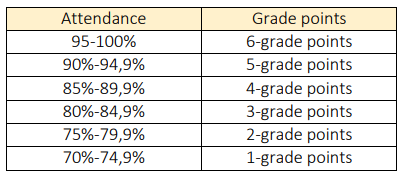
2) Adopted knowledge (up 64 points)
During classes, acquired knowledge will be evaluated by two midterm exams (MTE) comprising 70 questions. A student may obtain up to 32-grade points on each exam:
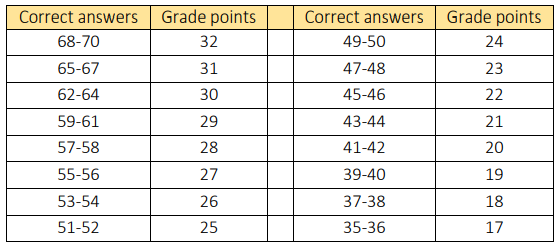
Students who fail to earn a minimum number of points one or both MTEs can repeat one or both MTEs, which will be organized in February, between the first and second term of the Final exam. At repeated MTEs, a student can acquire grade points according to the above table and correct/improve the final score.
Improvement of the overall performance during the course. Students who have achieved sufficient points on a regular MTEs can improve their final score at the repeated MTE/MTEs. The repeated MTEs (writing the test) will be organized at the Faculty of Medicine under controlled conditions: either using traditional printed tests or using the Merlin platform in the Faculty's computer classroom
Additional acquisition of minimum conditions for the Final exam. Students who failed to acquire a minimum score on one of the MTEs can earn minimum grades required to access the Final exam. This will be organized in early September. The acquisition of minimum grade pointe will be carried out by writing one or both tests covering the material of the first and/or second MTE. The acquisition of minimum grade points (writing a test) will be organized at the Faculty of Medicine under controlled conditions: either using traditional printed tests or using the Merlin platform in the Faculty's computer classroom. On testsfor the acquisition of minimum conditions,students cannot earn additional grade points. With a positive test result (more than 50%), a student can earn the minimum number of grade points (17.5+17.5) and can access the Final exam. If it is not possible to approach the Faculty due to the epidemiologic situation, additional acquisition of minimum conditions will be carried out by oral examination of the required materials using MS teams or Google Meets. At the oral check, students can achieve a positive result and earn the minimum number of points needed to enter the Final exam.
II. Final exam (up to 30-grade points)
Students who obtained 35-70 grade points during classes are obligated to access the final exam at which they may obtain additional grade points. The final exam consists of a multiple-choice questions test and an oral part. Students who obtained less than 35-grade points during classes or were absent for more than 30% of classes are not allowed to access the Final exam (insufficient F). Students can obtain 15-30 grade points at the final exam. The final exam consists of an oral and a written part, where students are expected to show at least 50% of knowledge, skills, and competencies. A student who demonstrates at least 50% of knowledge, skills, and competencies at the written and the oral part of the exam is credited with points according to the achieved result, which is added to the grade points obtained during classes.
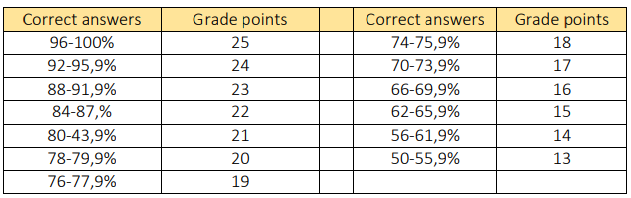
At the written part of the final exam, a student can obtain 13-25 grade points according to the table:
At the oral part of the final exam, a student can obtain 1-5 grade points that are divided into 5 categories (1, 2, 3, 4, 5).
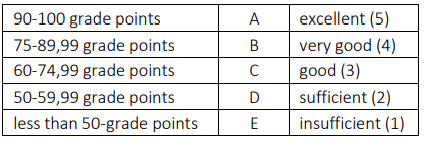
III. The final grade (maximum of 100-grade points) The final grade represents the sum of all grade points obtained during classes and at the final exam. It is based on the absolute redistribution according to the following scale:
Other important information regarding the course:
Course content and all information regarding the course, including exam information can be found at Merlin.
Learning outcomes
After the course, students should be able to:
Describe immunology as a biomedical science, the concept of immunity, immunity, immune system, and immune response. Explain the phylogenetic relationship between innate and adaptive immunity and their physiological tasks and features. List and explain the division of adaptive immunity according to the mode of acquisition and according to effector mechanisms (humoral and cellular immunity). Explain the forms of immune activity (immunoreaction, immune nonreactivity). Describe the morphological, physical, and biological properties of cells of the immune system. Describe the anatomy and function of lymphatic tissues (bone marrow, thymus, lymphatic system, lymph nodes, spleen, and regional lymphatic systems). List the subtypes of lymphocytes, basic differentiation markers on individual subsets of immune cells and describe their function. List subsets of T and B lymphocytes and describe their function. Describe the principles of migration of neutrophils, monocytes, and Ti B lymphocytes. Describe the distribution and recirculation of lymphocytes in the body. Describe the function of chemokines, chemokine receptors, and adhesion molecules on leukocytes and endothelial cells.
Learning material:
Chapter 1: Properties and Overview of Immune Responses, pages 1-12; Chapter 2: Cells and Tissues of the Immune System, pages 13-33; Chapter 3: Leukocyte Circulation and Migration into Tissues, pages 35-50. From Abbas A.K, Lichtman A.H., Pillai S. Cellular and Molecular Immunology. International Edition. Tenth edition. Elsevier, 2021.
Learning outcomes
After the course, students should be able to:
Describe the structure of antibodies, their heterogeneity and antigenic determinants, and the primary structure of the paratope. Understand the general laws of antigen and antibody binding, the affinity and avidness of binding molecules to recognize antigens, electrostatic forces in the reaction of antigens and antibodies. Describe the concept of antigen, antigen division, antigenic determinant (epitope) and its forms. Define the concept of immunogenicity, the factors on which antigen immunogenicity depends. Describe the principles of coupled recognition of antigens. Describe the principles of recognition of cytosolic and vesicular antigens. Describe the course of specialization of clone b lymphocytes for a certain specificity in the bone marrow.
Learning material:
Chapter 5: Antibodies and Antigens, pages 87-105. From Abbas A.K, Lichtman A.H., Pillai S. Cellular and Molecular Immunology. International Edition. Tenth edition. Elsevier, 2021.
Learning outcomes
After the course, students should be able to:
Understand the principles of creating a receptor repertoire of lymphocytic clones, the hypothesis of "forbidden" clones of specific immunity. Describe the mechanisms of antigen capture and the function of predominant cells. Explain the intercellular interactions of immune cells, especially predominant cells and T lymphocytes. Specify the division and explain the function of adhesion, coreceptor and co-stimulatory molecules. Describe the system of tissue antigens, their division, structure and function of MHC group I and II antigens, and distribution in the body. Understand the structure of the MHC gene (polygenia and polymorphism). Describe the role of the MHC gene in determining the characteristics of immunoreaction (in monitoring the response to individual antigens, in the occurrence of autoimmune diseases, in the occurrence of high alloreactivity). Explain the processing of foreign antigen and the mechanism of its binding to Class I and Class II MHC molecules.
Learning material:
Chapter 6: Major Histocompatibility Complex Molecules and Antigen Presentation to T Lymphocytes, pages 107-135. From Abbas A.K, Lichtman A.H., Pillai S. Cellular and Molecular Immunology. International Edition. Tenth edition. Elsevier, 2021.
Learning outcomes
After the course, students should be able to:
Define and describe immune receptor families. Describe the structure of receptors for antigen of T lymphocytes. Understand the mechanisms of activation of T lymphocytes (transmission of signals to the cell and their effects after stimulating antigen receptor). Describe the structure of the antigen receptor on B lymphocytes, and the mechanism of transmission of the activation signal to lymphocyte B. Describe inhibitory receptors of T and B lymphocytes and NK cells. Describe the structure and division of cytokine receptors, the mechanism of signal transmission by cytokine receptors.
Learning material:
Chapter 7: Immune Receptors and Signal Transduction, pages 137-169. Chapter 9: Activation of T lymphocytes, pages 199-212. From Abbas A.K, Lichtman A.H., Pillai S. Cellular and Molecular Immunology. International Edition. Tenth edition. Elsevier, 2021.
Learning outcomes
After the course, students should be able to:
Describe the structure of antigen receptors of T lymphocytes, and their heterogeneity. Describe the processes of maturation of T lymphocytes and the role of thymus in them. Describe the processes of primary and secondary maturation of B lymphocytes. Understand the multigene organization of antigen receptor genes, reshuffling mechanisms, and the assembly of functioning genes for the variable receptor region.
Learning material:
Chapter 8: Lymphocyte Development and Antigen Receptor Gene Rearrangement, pages 171.-198. From Abbas A.K, Lichtman A.H., Pillai S. Cellular and Molecular Immunology. International Edition. Tenth edition. Elsevier, 2021.
Learning outcomes
After the course, students should be able to:
Explain the mechanisms and main features of cellular immunity. Describe subsets of effector CD4+ T cells. Explain macrophage activation with sensitized T lymphocytes of TH1 subset. Explain the development and function of TH2 subset.. Explain the development and function of TH17 lymphocyte subset. Explain the characteristics and function of Tγδ cells and NKT cells. Describe the characteristics and explain the effector roles of cytotoxic T lymphocytes and the mechanism of killing target cells.
Learning material:
Chapter 10: Differentiation and Functions of CD4+ Effector T Cells, pages 213-230. Chapter 11: Differentiation and Functions of CD8+ Effector T Cells, pages 231-238. From Abbas A.K, Lichtman A.H., Pillai S. Cellular and Molecular Immunology. International Edition. Tenth edition. Elsevier, 2021.
Learning outcomes
After the course, students should be able to:
Describe the mechanisms of antigen recognition and antigenic activation of B lymphocytes. Describe the morphology of B lymphocyte differentiation, plasma cells and memory cell formation in T lymphocyte-dependent reactions. Understand the gene mechanism for switching heavy chain classes. Understand the gene mechanisms that are the source of the diversity of antibodies (creating a repertoire of antibody specificities). Understand the affinity maturation of immunoglobulins and switching IgM to IgG, and the mechanism by which a single plasma cell creates one type of immunoglobulin (allelic shutdown). Explain the kinetics of antibody formation in primary and secondary immunoreaction, distribution by body, and dynamics of antibody degradation. Explain the functions and biological properties of a particular class of antibodies. Explain the mechanism of cell uterine antibody-dependent cytotoxicity. Describe natural-killing (NK) activity, receptors on the surface of NK cells, and lymphokine-activated killer activity (LAC). Describe the classical, lectin, and alternative complement activation pathway. Describe the biological role of complement.
Learning material:
Chapter 12: Cell Activation and Antibody Production, pages 239-263. Chapter 13: Effector Mechanisms of Humoral Immunity, pages 265-288. From Abbas A.K, Lichtman A.H., Pillai S. Cellular and Molecular Immunology. International Edition. Tenth edition. Elsevier, 2021.
Learning outcomes
After the course, students should be able to:
To describe the structure of the immune system at the epithelial barriers. To describe the immunity of the digestive system and other mucous membranes. To describe the function of M cells. To explain the induction of the mucosal TH2 immune response. To explain the induction of the mucosal inflammatory TH1 immune response. To explain the structure, function, and secretion of IgA antibodies. To explain the function of γδ-T lymphocytes. To explain the function of immunoregulatory cytokines (TGF-beta, IL-10) and regulatory T lymphocytes in mucosal immunity. To describe the immunity of the skin and immune-privileged tissues.
Learning material:
Chapter 14: Specialized Immunity at Epithelial Barriers and in Immune Privileged Tissues, p. 289-313. From Abbas A.K, Lichtman A.H., Pillai S. Cellular and Molecular Immunology. International Edition. Tenth edition. Elsevier, 2021.
Learning outcomes
After the course, students should be able to:
To define the term immunologic hypersensitivity, to name the classification of immunologic hypersensitivity, and to describe their main characteristics. To explain the immune diseases caused by antibodies. To explain hypersensitivities caused by immunocomplexes. To explain diseases caused by T lymphocytes. To explain cell-dependent hypersensitivity features, tuberculin response, and contact hypersensitivity. To describe the pathogenesis and treatment strategies of selected immune diseases (SLE, RA, multiple sclerosis, type 1 diabetes, inflammatory bowel diseases).
Learning material:
Chapter 19: Hypersensitivity Disorders, pages 399-416. From Abbas A.K, Lichtman A.H., Pillai S. Cellular and Molecular Immunology. International Edition. Tenth edition. Elsevier, 2021.
Learning outcomes
Learning outcomes - After the course, students should be able to:
Explain the term immunologic tolerance, the mechanisms for establishing tolerance at birth, and in adulthood. Describe the factors that affect tolerance (maturity of the immune system, antigen features, antigen dose, and antigen intake pathway). Explain the mechanisms of central (perinatal) and peripheral immunologic tolerance (disappearance of clones, clonal anergy, immune neglect, immune-privileged sites, redirection of the immune response, facilitative antibodies, and blocking factors), and mechanisms of immunologic tolerance termination. Describe the active suppressive mechanism at the periphery, the suppressive cells, and the activity of suppressive cytokines. Describe the immunologic relationship between a mother and a child and the mechanisms that prevent fetal rejection. Explain the term autoimmunity, mechanisms for autoimmunity occurrence (the role of autoantigen, the role of external antigen as an immunogenic carrier, to describe the cross-reaction). To describe the features of autoreactive T and B lymphocyte occurrence at the periphery. Explain the pathogenic mechanisms of autoimmunity and the mechanisms of tissue and organ damage by antibodies, antigen-antibody complexes, and T lymphocytes. Describe autoimmune diseases and their classification, genetic factors of autoimmunity, the influence of gender, age, infections, and immunologic disorders on the occurrence of autoimmunity. Name the principles of treating autoimmune diseases.
Learning material:
Chapter 15: Immunologic Tolerance and Autoimmunity, pages 315-337. From Abbas A.K, Lichtman A.H., Pillai S. Cellular and Molecular Immunology. International Edition. Tenth edition. Elsevier, 2021.
Learning outcomes
After the course, students should be able to:
Define the term allergy. Describe the formation of IgE-class antibodies. Explain the role of TH2 cells, mast cells, basophils, and eosinophils in allergic reactions. Explain anaphylactic hypersensitivity and its forms. Describe IgE-class antibodies and receptors for the Fc fragment of IgE, to describe target cell degranulation, as well as secretion and function of mediator substances (primary and secondary mediators). Describe allergic diseases in humans and the principles of their treatment.
Learning material:
Chapter 20: Allergy, pages 417-435. From Abbas A.K, Lichtman A.H., Pillai S. Cellular and Molecular Immunology. International Edition. Tenth edition. Elsevier, 2021.
Learning outcomes
After the course, students should be able to:
Describe tumor antigens, their subtypes, properties, and methods for demonstrating tumor antigens and human tumor antigens. Describe the immune response to the tumor, and subtypes of immune resistance to a tumor (cellular and humoral immunity). Understand the theory of immune surveillance over tumor cells, and tumor suppression mechanisms to immune defense. Describe the tumor immunotherapy and its subtypes. Describe the role of innate and adaptive immunity in promoting tumor growth.
Learning material:
Chapter 18: Immunity to Tumors, pages 383-397. FromAbbas A.K, Lichtman A.H., Pillai S. Cellular and Molecular Immunology. International Edition. Tenth edition. Elsevier, 2021.
Learning outcomes
After the course, students should be able to:
Define immunodeficiency and its classification. Explain primary immunodeficiencies and disorders of their immune effectors (deficiency of B lymphocytes, T lymphocytes, phagocytes, complement system, and associated T and B lymphocyte deficiencies). Explain secondary immunodeficiencies and the reasons for their occurrence. Describe the structure and biological behavior of HIV, the way of transmission, the mechanism by which it causes AIDS, AIDS (incubation, seroconversion, symptoms, and the course of the disease).
Learning material:
Chapter 21: Congenital and Acquired Immunodeficiencies, pages 437-463. From Abbas A.K, Lichtman A.H., Pillai S. Cellular and Molecular Immunology. International Edition. Tenth edition. Elsevier, 2021.
Learning outcomes
Discussion: Content of Lecture 3 The training section includes PhysioEx 9.1 Exercise 12: Serological Testing; Activity 1: Use of direct immunofluorescence technique in pathogen detection; Activity 3: ELISA.
Learning material:
Chapter 5: Antibodies and Antigens, pages 87-105. From Abbas A.K, Lichtman A.H., Pillai S. Cellular and Molecular Immunology. International Edition. Tenth edition. Elsevier, 2021.
Learning outcomes
Discussion: Content of the Lecture 7 and 8, and Big seminar 2
The training section includes presentations of cases of Chron's disease/ulcerative colitis and sepsis.
Learning material:
Chapter 13: Effector Mechanisms of Humoral Immunity, pages 265-288. Chapter 14: Specialized Immunity at Epithelial Barriers and in Immune Privileged Tissues, pages 289-313. From Abbas A.K, Lichtman A.H., Pillai S. Cellular and Molecular Immunology. International Edition. Tenth edition. Elsevier, 2021.
Learning outcomes
Discussion: Lectures 9, and 10
The training section includes a video of anaphylactic shock in a guinea pig and a display of cases of allergy and autoimmune disease (rheumatoid arthritis).
Learning material:
Chapter 15: Immunotolerance and Autoimmunity, pages 315-337. Chapter 19: Hypersensitivity disorders, pages 399-416. Chapter 20: Allergy, pages 417-435. Abbas A.K, Lichtman A.H., Pillai S. Cellular and Molecular Immunology. International Edition. Tenth edition. Elsevier, 2021.
Learning outcomes
Repetition: Lectures 12, and 13
Learning material:
Chapter 18: Immunity to Tumors, page 383-397. Chapter 21: Innate and Acquired Immunodeficiencies, pages 437-463. From Abbas A.K, Lichtman A.H., Pillai S. Cellular and Molecular Immunology. International Edition. Tenth edition. Elsevier, 2021.
Learning outcomes
Discussion: Content of Lecture 1 and Big seminar 1
Learning material:
Chapter 1: Properties and Overview of Immune Responses, pages 1-12. Chapter 2: Cells and Tissues of the Immune System, pages 13-33. Chapter 3: Leukocyte Circulation and Migration into Tissues, pages 35-50. Chapter 4: Innate Immunity, pages 51-86. From Abbas A.K, Lichtman A.H., Pillai S. Cellular and Molecular Immunology. International Edition. Tenth edition. Elsevier, 2021.
Learning outcomes
After the course, students should be able to:
Describe the development and the mechanisms for innate immunity (anatomical, physiological, cellular, inflammatory obstacles). Name the cellular receptors for molecular pattern recognition and their function in innate immunity. To describe the mechanism of chemotaxis, endocytosis, and phagocytosis, and decomposition of phagocytic particles. Describe classical, lectin, and alternative complement activation pathways. Describe the biological role of the complement. Describe the regulation of complement activation. Define inflammation and to describe the mechanism of inflammatory response. Describe the mechanism of innate antiviral response.
Learning material:
Chapter 4: Innate Immunity, pages 51-86. From Abbas A.K, Lichtman A.H., Pillai S. Cellular and Molecular Immunology. International Edition. Tenth edition. Elsevier, 2021.
Learning outcomes
After the course, students should be able to:
Explain the terms parasitism, pathogenicity, virulence, and infection. Describe the features of the immune response (non-specific and specific immunity) to pathogenic microbes. Explain the features of specific immunity in infections, specific active immunity acquired naturally, and artificially triggered specific active immunity, the concept, and principle of vaccination and forms of specific passive immunity (acquired naturally and artificially triggered specific passive immunity). Describe the basic features of viruses, bacteria, single-cell and multiple-cell parasites, and infections caused by these parasites. Explain the features of innate and adaptive immunity to extracellular and intracellular bacteria, fungi, viruses, and single-cell and multiple-cell parasites.
Learning material:
Chapter 16: Immunity to Microbes, pages 339-354. From Abbas A.K, Lichtman A.H., Pillai S. Cellular and Molecular Immunology. International Edition. Tenth edition. Elsevier, 2021.
Learning outcomes
After the course, students should be able to:
Define levels of immunogenic compatibility. Explain the principles of transplant immunology. Explain the mechanisms of transplant response, to name the evidence that transplant response is an immune response. Name and describe the forms of transplant response depending on the rate and the rejection mechanism, and to describe the reaction of mixed lymphocytes. Explain the features of non-lymphatic tissue and organ transplantation and xenogeneic organ transplantation. Explain the features of lymphatic tissue transplantation (bone marrow), the reaction of the graft against the receiver, and the transplant disease.
Learning material:
Chapter 17: Transplantation Immunology, pages 359-371 and 376-381. From Abbas A.K, Lichtman A.H., Pillai S. Cellular and Molecular Immunology. International Edition. Tenth edition. Elsevier, 2021.
Priručnik za vježbe iz fiziologije, neurofiziologije i imunologije [Handbook for Practicals in Physiology, Neurophysiology, and Immunology], Rijeka, 2001, practical no. 20.
Learning outcomes
Discussion: Content of Lecture 2, 4, and 5
Learning material:
Chapter 10: Differentiation and Functions of CD4+ Effector T Cells, pages 213-230. Chapter 11: Differentiation and Functions of D8+ Effector T Cells, pages 231-238. From Abbas A.K, Lichtman A.H., Pillai S. Cellular and Molecular Immunology. International Edition. Tenth edition. Elsevier, 2021.
Learning outcomes
Discussion: Content of the Lecture 7 and 8, and Big seminar 2 The training section includes presentations of cases of Chron's disease/ulcerative colitis and sepsis.
Learning material:
Chapter 13: Effector Mechanisms of Humoral Immunity, pages 265-288. Chapter 14: Specialized Immunity at Epithelial Barriers and in Immune Privileged Tissues, pages 289-313. From Abbas A.K, Lichtman A.H., Pillai S. Cellular and Molecular Immunology. International Edition. Tenth edition. Elsevier, 2021.
Learning outcomes
After the course, students should be able to:
Describe the possibilities for action on the intensity of the immune response (immunosuppression, immunostimulation). Explain immunosuppression, mechanisms for inducing specific (suppression of immune response by antigens, antibodies, antilymphocyte serum, monoclonal antibodies) and non-specific (corticosteroids, cytostatics) immunosuppression. Explain immunostimulation procedures by vaccination for protection against infection. Name the properties of vaccines and their types. Explain vaccination by weakened pathogens. Explain vaccination by conjugated vaccines. Explain vaccination against bacterial toxins. Explain vaccination by recombinant, alive viral, and DNA vaccines. Describe the methods of genetic engineering in methods of preparing antitumor vaccines and enhancement of antitumor immune response. Name the types of adjuvants and to explain the principles of their action.
Learning material:
Chapter 17: Transplant immunology (Prevention and treatment of graft rejection), pages 371-376. Chapter 16: Immunity to microorganisms (Vaccine Development Strategies), pages 354-357. From Abbas A.K, Lichtman A.H., Pillai S. Cellular and Molecular Immunology. International Edition. Tenth edition. Elsevier, 2021.
Learning outcomes
Discussion: Lectures 9, and 10 The training section includes a video of anaphylactic shock in a guinea pig and a display of cases of allergy and autoimmune disease (rheumatoid arthritis).
Learning material:
Chapter 15: Immunotolerance and Autoimmunity, pages 315-337. Chapter 19: Hypersensitivity disorders, pages 399-416. Chapter 20: Allergy, pages 417-435. From Abbas A.K, Lichtman A.H., Pillai S. Cellular and Molecular Immunology. International Edition. Tenth edition. Elsevier, 2021.
Learning outcomes
Repetition: Lectures 12, and 13
Learning material:
Chapter 18: Immunity to Tumors, page 383-397. Chapter 21: Innate and Acquired Immunodeficiencies, pages 437-463. From Abbas A.K, Lichtman A.H., Pillai S. Cellular and Molecular Immunology. International Edition. Tenth edition. Elsevier, 2021.
| Academic year | |
|---|---|
| 2023/2024 | [Download] |